
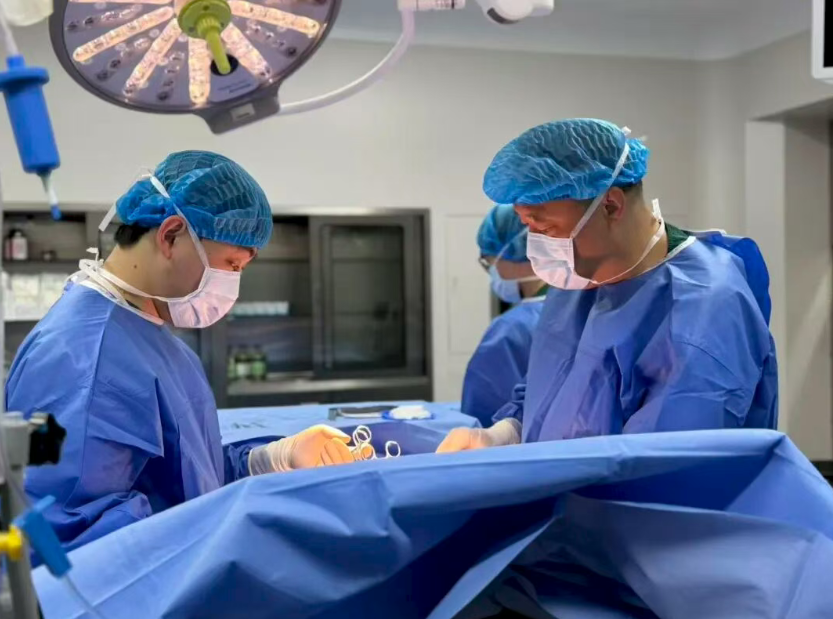
High-risk colon cancer patient with multiple co-morbidities successfully saved via multidisciplinary minimally invasive NOSES surgery.
The patient presented with a complex clinical picture involving concurrent gastrointestinal bleeding, complete intestinal obstruction, and hemorrhage from a ruptured intestinal tumor, compounded by multiple underlying conditions such as diabetes, hypertension, and severe pneumonia. The patient also had a history of cardiac arrest and prior ICU admission for critical illness. This combination of complex pathology and multiple high-risk factors posed immense challenges at every stage of diagnosis and treatment. A multidisciplinary team led by Professor Zhang Tiemin from the Department of Gastrointestinal Surgery at Heyou Hospital—collaborating with the Departments of Gastroenterology, Anesthesiology, and Critical Care Medicine (ICU), as well as the nursing team—performed a laparoscopic minimally invasive NOSES procedure (Natural Orifice Specimen Extraction Surgery). This approach enabled the resection of the diseased intestinal segment, relief of the obstruction, and control of the bleeding with minimal surgical trauma. Following two weeks of comprehensive, systematic treatment and care, the patient successfully navigated the perioperative period and was discharged in stable condition.
Acute Gastrointestinal Bleeding: Identifying Critical Intestinal Lesions
The patient was transferred to the Department of Gastroenterology for specialized treatment of gastrointestinal bleeding. In patients with multiple underlying conditions, persistent gastrointestinal bleeding can rapidly exacerbate anemia and disrupt circulatory function—potentially leading to shock—thereby necessitating prompt identification of the cause and targeted intervention.
The gastroenterology team immediately conducted comprehensive examinations, revealing a mass measuring approximately 5×6 cm in the large intestine. This mass had caused severe narrowing and complete occlusion of the intestinal lumen, resulting in a classic complete bowel obstruction; furthermore, ulceration and bleeding from the mass were identified as the primary cause of the patient’s gastrointestinal hemorrhage. Given the patient’s critical condition, the department immediately initiated an emergency transfer protocol, moving the patient to the Department of Gastrointestinal Surgery for further life-saving treatment.
Complications from multiple overlapping conditions make surgical intervention extremely high-risk.
After the patient was transferred to the Department of Gastrointestinal Surgery, Professor Zhang Tiemin, the department head, led a comprehensive assessment of the patient’s condition and organized a multidisciplinary consultation. The medical team determined that failure to promptly relieve the intestinal obstruction would lead to a cascade of severe complications—such as intestinal ischemia, necrosis, perforation, and abdominal infection—which could easily trigger septic shock and pose an immediate threat to life.
The patient presented with underlying conditions including diabetes, hypertension, and severe pneumonia, as well as a history of critical care in the ICU and cardiac arrest. Consequently, the patient’s physiological tolerance for anesthesia and surgery was significantly compromised, carrying a high risk of intraoperative circulatory instability, postoperative infection, cardiopulmonary failure, and poor wound healing. Although the patient fell into the “extremely high-risk” category for surgery, conservative treatment had failed to control the intestinal obstruction and persistent bleeding—conditions that also carried a fatal risk—making surgical intervention the only viable life-saving option.
Professor Zhang Tiemin noted that the key to treating such patients lies in relieving the obstruction, resecting the lesion, and controlling bleeding within the shortest possible time, while simultaneously minimizing surgical trauma to ensure the patient safely navigates anesthesia and the perioperative period.
Customized Minimally Invasive Approach: NOSES Surgery Reduces Treatment Trauma
Given the patient’s high-risk, critical physical condition, Professor Zhang Tiemin’s team tailored a minimally invasive laparoscopic NOSES (Natural Orifice Specimen Extraction Surgery) plan. As a cutting-edge technique in minimally invasive gastrointestinal surgery, this procedure eliminates the need for large abdominal incisions or a dedicated opening for specimen extraction; instead, the diseased tissue is removed via the natural anal orifice, leaving only a few tiny puncture wounds on the body surface.
Compared to traditional surgical methods, NOSES offers significant advantages, including reduced trauma, less intraoperative pain, faster postoperative recovery, and a lower incidence of abdominal wall incision complications. For this high-risk patient—who presented with multiple underlying medical conditions and a history of cardiac arrest—the minimally invasive approach effectively minimized intraoperative blood loss, lowered the risk of postoperative infection, and reduced physiological stress, thereby greatly enhancing the safety of perioperative care.
During the procedure, Professor Zhang Tiemin’s team leveraged their extensive experience in minimally invasive tumor surgery to meticulously dissect tissues and precisely manage blood vessels. They successfully performed a complete resection of the diseased intestinal segment and completed intestinal reconstruction while ensuring minimal trauma and blood loss. The surgery proceeded smoothly, with the patient’s vital signs remaining stable throughout. Postoperatively, only four tiny incisions (0.5–1 cm) remained on the abdomen; this approach significantly reduced the physical impact of the surgery, laying a solid foundation for rapid recovery.
Smooth postoperative recovery; long-term adjuvant therapy proceeding in an orderly manner.
Postoperative pathological analysis confirmed a diagnosis of sigmoid colon adenocarcinoma, with the tumor measuring approximately 8 × 7.5 × 3 cm. Under the meticulous monitoring and systematic clinical management of the hospital’s multidisciplinary medical team, the patient experienced no serious postoperative complications—such as infection or secondary hemorrhage—and showed steady improvement in both physical and mental well-being, ultimately making a successful recovery and being discharged. Moving forward, the medical team will formulate a personalized plan based on the patient’s pathological stage and overall health status to systematically administer adjuvant therapy.
Summary of Expert Diagnosis and Treatment, and Cancer Screening Reminders
The successful treatment of this high-risk, critically ill patient with colorectal cancer was made possible by the hospital’s multidisciplinary team, which ensured a rapid response, precise assessment of the patient’s condition, the formulation of a personalized minimally invasive treatment plan, and standardized perioperative management throughout the entire process.
Professor Zhang Tiemin noted that when treating patients with complex, critical tumors, surgical feasibility cannot be determined in isolation. Instead, a comprehensive approach is required—evaluating the tumor’s characteristics, underlying medical conditions, anesthesia tolerance, cardiopulmonary function, immune resilience against infection, and potential for postoperative recovery—to tailor an optimal, personalized treatment plan that ensures safe and highly effective care.
Experts also emphasize that colorectal cancer is a highly prevalent malignancy; in its early stages, it often presents without typical symptoms and is highly insidious. Individuals over the age of 40—particularly those at high risk due to factors such as a family history of colorectal cancer, chronic or recurrent constipation or diarrhea, blood in the stool, chronic enteritis, a history of intestinal polyps, irregular dietary habits, long-term smoking and alcohol consumption, or obesity—should undergo regular gastrointestinal endoscopic screening. Prioritizing early screening, diagnosis, and treatment is crucial for improving clinical outcomes, avoiding severe complications, and reducing mortality associated with the disease.