
In the race for life, time is of the essence; every second can determine the difference between life and death. Recently, the team led by Professor Chi Luxiang at the Chongqing Raffles Pan-Vascular Disease Management Center executed a dramatic life-saving intervention, successfully performing surgery on Mr. Xie, a 66-year-old patient suffering from an acute stroke, and pulling him back from the brink of death.
Critical Moment: Stroke Strikes, Life Hanging by a Thread
Mr. Xie suddenly experienced limb weakness and slurred speech and was rushed to Chongqing Raffles Hospital. Emergency imaging assessments confirmed a diagnosis of acute ischemic stroke. By this time, the patient had already missed the optimal time window for intravenous thrombolysis, rendering standard thrombolytic therapy unfeasible. With the blood vessel remaining occluded and brain tissue suffering progressive ischemic necrosis, the patient faced an imminent risk of massive cerebral infarction and cerebral herniation—conditions that could prove fatal.
Acute stroke treatment relies on a strict “golden window” for intervention. Once a large vessel is occluded, conservative treatment after this window passes yields a very poor prognosis, with significantly higher rates of disability and mortality. Faced with this complex clinical challenge, Professor Chi Luxiang’s team immediately activated the stroke emergency “green channel.” They rapidly conducted a multidisciplinary consultation to comprehensively assess vascular conditions and the extent of cerebral ischemia, subsequently formulating an interventional surgical plan.
Precision Intervention: Minimally Invasive Surgery Saves the Day
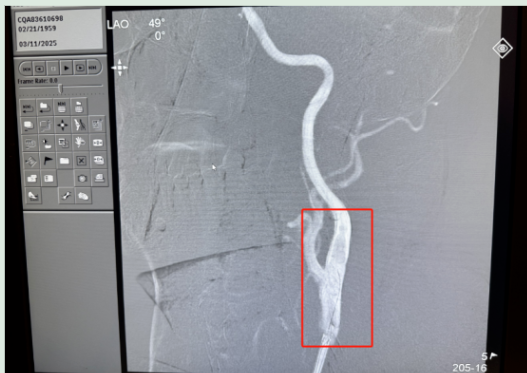
The team decided to perform **thrombus aspiration and carotid artery stenting** for Mr. Xie. This type of minimally invasive neuro-interventional procedure requires no craniotomy—leaving only a tiny puncture wound—but demands exceptional precision and diagnostic skill from the surgical team.
During the procedure, guided by digital subtraction angiography (DSA) equipment, Professor Chi and his team navigated a micro-catheter from the femoral artery into the intracranial space. They precisely reached the site of the occlusion, successfully aspirated and removed the obstructing thrombus, and simultaneously implanted a stent into the narrowed carotid artery to restore blood flow to the brain. The surgery was completed successfully; the occluded vessel was reopened, and blood supply to the brain tissue was rapidly restored.
Following the procedure, the patient was transferred to the Intensive Care Unit (ICU) for close monitoring. Following collaborative management by the critical care, neurology, neurosurgery, and nursing teams, the patient’s limb strength and speech function gradually recovered; the patient was successfully transferred out of the intensive care unit and, after undergoing subsequent rehabilitation, returned to a normal life.