
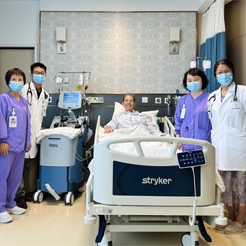
Since CAR-T therapy was approved for marketing in China, the Shanghai Jiahui International Cancer Center has worked with domestic and international partners to actively build an international CAR-T diagnosis and treatment platform in areas such as clinical experience sharing, academic exchange, and blood cancer education. At the same time, the multidisciplinary treatment team at Jiahui International Cancer Center has kept pace with international advanced standards and carried out a series of explorations in the clinical practice of new concepts and new technologies, hoping to bring new hope of cure to more patients with hematologic malignancies. The first foreign patient in China to receive axicabtagene ciloleucel CAR-T therapy was discharged smoothly three weeks after CAR-T cell infusion. On the day of discharge, the Jiahui medical and nursing team, who had accompanied the patient through every difficult moment of treatment, gathered with the patient’s family and friends outside the ward of the cancer center and prepared a special “discharge commemorative ceremony” for the patient to congratulate her on successfully completing CAR-T therapy.
A Foreign Mother of Three Diagnosed in Shanghai with “Primary Refractory” Lymphoma
Lyn comes from Singapore, is 40 years old, is a mother of three, and has lived in Shanghai for 15 years. Leading a healthy life, Lyn enjoys gathering with friends and has always maintained a fitness habit. In mid-2022, Lyn suddenly felt severe pain in the shoulder, neck, and upper limbs and could not sleep well all night. At first, Lyn thought it was a stiff neck, but after some time the symptoms became increasingly severe and even affected breathing. Lyn went to the emergency department of Shanghai Jiahui International Hospital for examination, where a huge mass 15 cm in diameter was found in the mediastinum. The compression from the large mass not only caused limb pain but also affected the nearby heart, great vessels, and lungs, leading to superior vena cava syndrome (SVCS), at one point causing difficulty breathing and posing an immediate life threat. The Jiahui hematology-oncology team quickly confirmed the diagnosis of “primary mediastinal large B-cell lymphoma” through biopsy pathology. This is a relatively rare lymphoma subtype, occurring mostly in young people, especially women.
After rapid confirmation of the diagnosis, the Jiahui hematology-oncology team immediately conducted an MDT multidisciplinary discussion and quickly formulated a comprehensive intensified treatment plan for Lyn. Lyn subsequently underwent comprehensive treatments including chemotherapy combined with targeted therapy and consolidation radiotherapy. Unfortunately, Lyn was insensitive to both chemotherapy and radiotherapy; the lymphoma shrank by half and then stopped shrinking, and soon began to progress. Lyn’s condition belonged to “primary refractory” lymphoma; patients who fail to achieve complete remission through standard chemoradiotherapy or who relapse and progress soon after treatment generally have a poor prognosis. Therefore, after full evaluation by the Jiahui hematology-oncology team and in accordance with international and domestic guideline recommendations, the team unanimously concluded that Lyn urgently needed more effective new treatment. The CDE website announced that CAR-T cell immunotherapy was officially approved in China for second-line treatment of adult large B-cell lymphoma, once again igniting Lyn’s hope.
CAR-T therapy, namely “chimeric antigen receptor T-cell therapy,” is a major breakthrough in individualized cellular immunotherapy for human cancer. It mainly involves collecting the patient’s T cells, performing in vitro genetic engineering modification to enhance the ability of T cells to specifically recognize tumors; subsequently, a large number of expanded “armed” T cells (i.e., CAR-T cells) are infused back into the patient to precisely kill tumor cells, and they can also form immune memory T cells, thereby achieving specific and durable antitumor effects.
Currently, the approved indications for CAR-T in China are lymphoma and myeloma. Because different patients have individualized particularities, and CAR-T therapy involves multiple key steps such as patient screening, bridging therapy, adverse reaction management, and long-term follow-up, this therapy places extremely high demands on the professionalism of the hematology-oncology team and the comprehensive diagnosis and treatment capabilities of multiple departments. Therefore, it needs to be carried out in medical centers with rich experience in hematologic tumor diagnosis and treatment and with multidisciplinary comprehensive construction.
Should they choose Shanghai, return to Singapore, or go to the United States for treatment? After careful consideration, Lyn’s family ultimately decided to undergo this internationally advanced medical therapy at Shanghai Jiahui International Hospital. Lyn’s husband shared that there were multiple factors behind this decision: first, considering the children’s schooling in Shanghai; second, the cost of CAR-T treatment abroad is far higher than in China and the waiting period is at least 3–6 months; third and most importantly, their trust in the clinical comprehensive strength and comprehensive medical support of Shanghai Jiahui International Hospital. From the first visit to the emergency department, the professionalism and meticulous care of the Jiahui team left a deep impression on Lyn’s family, and staying at Jiahui allowed them to enjoy an internationally advanced diagnosis and treatment experience in a familiar city. Facts proved that the decision at that time was very correct. The Jiahui International Cancer Center quickly launched the CAR-T clinical process, hoping to seize the best treatment timing for Lyn.
CAR-T Initiation: Everything Advanced Intensely but Orderly
As the first international hospital in Shanghai able to carry out CAR-T therapy, Shanghai Jiahui International Hospital attached great importance to this project. For this treatment, departments including the cancer center, cardiovascular medicine, neurology, ICU, respiratory medicine, gastroenterology, nephrology, imaging, laboratory medicine, and pharmacy, as well as the cancer center nursing team, collaborated closely, repeatedly conducting multiple rounds of training and scenario simulations in the early stage and promptly updating the patient’s condition.
After preliminary bridging therapy, infection screening, and pre-collection confirmation, the Jiahui hematology team collected Lyn’s cells and successfully completed the infusion of CAR-T cells.
After completion of the infusion, the Jiahui multidisciplinary team stood ready and closely monitored changes in Lyn’s various physical indicators and symptoms. On the 7th day after infusion, Lyn developed CRS symptoms such as fever, hypotension, and vomiting. The Jiahui medical and nursing team promptly carried out treatment according to the emergency plan previously formulated, bringing the condition under control in a timely manner. After CAR-T cell infusion, the “T-cell special forces” entering the body expanded well, and the patient’s pain symptoms caused by the tumor were relieved. After clinical evaluation confirmed stable condition, Lyn smoothly “exited the unit,” returning from the separately set CAR-T dedicated isolation ward to the general oncology ward. Lyn was discharged smoothly. Although long-term monitoring and subsequent treatment were still needed afterward, the most difficult hurdle had been safely passed.
Cutting-Edge Therapy Lands in China, Multidisciplinary Professional Team Provides Support
For Lyn, Shanghai is a city of different significance. During the 15 years Lyn and family lived in Shanghai, they not only witnessed the gradual improvement of Shanghai’s overall international image but also personally experienced that the application of new medical technologies in Shanghai is advancing with great strides toward the global frontier level of Europe and the United States. It is understood that Lyn was the first CAR-T patient at Shanghai Jiahui International Hospital and also the first foreign patient in China to complete axicabtagene ciloleucel CAR-T therapy. The successful implementation of this therapy at Shanghai Jiahui International Hospital cannot be separated from Lyn’s trust in and recognition of domestic medical quality, and it further proves Jiahui’s comprehensive strength in the field of international medicine.
It is reported that the Jiahui International Cancer Center of Shanghai Jiahui International Hospital has completed multiple CAR-T training certifications and has been authorized for treatment certification and carried out clinical application of CAR-T cell therapy. In terms of cost, CAR-T expenses mainly include two parts—drug costs and non-drug costs. The total treatment cost of this therapy in China is far lower than in the United States and other European and American countries, and commercial insurance payment has been opened, with other payment methods also to be implemented. At present, CAR-T treatment services are jointly linked with the international diagnosis and treatment platform and Shanghai’s local high-quality medical resources to provide patients in need with CAR-T-related diagnosis and treatment services, including outpatient consultation, screening and evaluation, T-cell collection, CAR-T cell infusion, and adverse reaction monitoring and management. With reference to international CAR-T clinical application guidelines, Jiahui has formulated standard service processes and a quality control system to safeguard customized treatment for patients; at the same time, the cancer center, cardiovascular medicine, neurology, ICU, respiratory medicine, gastroenterology, nephrology, imaging, laboratory medicine, and pharmacy departments, as well as the cancer center nursing team, form a CAR-T multidisciplinary clinical professional team. The hospital is equipped with advanced T-cell extraction equipment and CAR-T dedicated wards, fully ensuring patient monitoring needs and comfort experience in both hardware and software.