
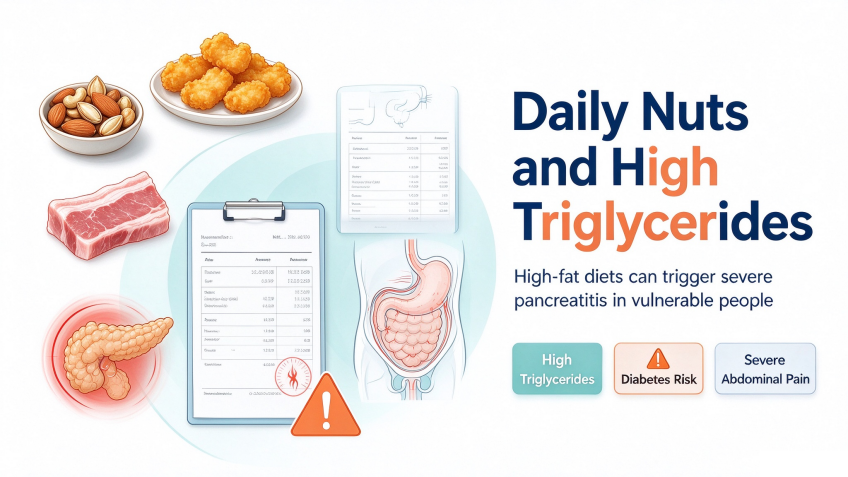
Man lands in ICU with sky-high blood lipid levels after daily nut consumption
Mr. Fang (a pseudonym), 41, never imagined that simply eating an extra handful of nuts would land him in the intensive care unit (ICU) and necessitate emergency interventions, including hemofiltration. The culprit behind this crisis was acute pancreatitis triggered by hyperlipidemia—a condition brought on by a high-fat intake—which, compounded by his existing underlying health issues, made his situation exceptionally perilous.
On the day of the incident, shortly after consuming a large quantity of nuts, Mr. Fang began experiencing persistent upper abdominal pain. His family rushed him to Xi’an Gaoxin Hospital, where CT scans and amylase level tests confirmed a diagnosis of acute pancreatitis. Further examination revealed that his triglyceride levels had skyrocketed to 82.40 mmol/L (the normal range is typically <1.7 mmol/L). He was also suffering from diabetic ketoacidosis and hyperglycemia. Given his medical history—which includes coronary heart disease (with prior coronary stent placement) and type 2 diabetes—his case presented a complex scenario of multiple pre-existing systemic conditions combined with an acute, severe illness.
Physicians in the Department of Gastroenterology at Xi’an Gaoxin Hospital identified the condition as “hyperlipidemia-induced pancreatitis”—a type often triggered by overeating or the excessive consumption of high-fat foods. With his triglyceride levels dangerously high, immediate lipid-lowering intervention was essential to prevent the pancreatic inflammation from worsening and becoming life-threatening. Because medication alone would not act quickly enough, Mr. Fang was transferred to the ICU for hemofiltration—a critical procedure used to rapidly clear triglycerides from the bloodstream. After three days of intensive care, his triglyceride levels plummeted from an off-the-charts 82.40 mmol/L to 2.99 mmol/L. His ketoacidosis was resolved, and his abdominal pain subsided, allowing him to be moved back to a general ward.
Just as it seemed he was on the mend, however, Mr. Fang attempted to take a sip of water—only for the abdominal pain to flare up once again, accompanied by a high fever. A follow-up CT scan revealed that Mr. Fang’s pancreatitis had progressed to Balthazar grade D. There was increased peripancreatic exudation, the inflammation had spread to the adjacent intestines, and a secondary infection had developed. The gastroenterology team promptly adjusted his treatment plan. With careful management, Mr. Fang’s abdominal pain was brought under control; he was eventually able to resume eating without any recurrence of pain and was successfully discharged.
Following his discharge, Mr. Fang has strictly adhered to a low-fat diet and consistently taken his lipid-lowering medication. Subsequent outpatient check-ups have shown his triglyceride levels remaining within the normal range, and his condition has stayed stable.
The Department of Gastroenterology at Xi’an Gaoxin Hospital notes that autumn and winter are peak seasons for acute pancreatitis. Individuals with underlying health conditions, in particular, should be wary of the risks posed by overindulging in food. Please keep the following four points in mind:
High-fat diets are “silent killers”:
While high-fat foods—such as nuts, fatty meats, and fried items—may be delicious, consuming them in excess can trigger hyperlipidemia-induced pancreatitis. Those who already have high blood lipid levels should exercise particular restraint.
Higher risk for those with underlying conditions:
Individuals with pre-existing conditions such as diabetes, coronary heart disease, or hyperlipidemia already have more vulnerable pancreatic function and metabolic systems. They should avoid overeating, stick to a light, low-fat diet, and regularly monitor relevant health indicators.
Do not “tough out” abdominal pain:
Sudden, persistent upper abdominal pain—accompanied by symptoms like bloating or nausea—could be a sign of acute pancreatitis. Seek medical attention immediately; delaying treatment can lead to a rapid deterioration of the condition.
Dietary care during recovery:
During recovery from pancreatitis, patients should follow a gradual dietary progression: starting with water, then moving to clear liquids, semi-liquids, and finally soft foods. Do not resume eating or drinking too soon, as this could irritate the pancreas and trigger a recurrence of inflammation.
Although hyperlipidemia-induced acute pancreatitis is a serious and dangerous condition, it can be effectively managed through timely medical intervention, evidence-based treatment, and long-term health management following discharge. Do not let a fleeting craving for food cause irreversible harm to your body. This is especially critical for those with underlying medical conditions, who must take to heart the importance of “controlling one’s diet and following medical advice.”
Digestive Disease Hospital, Xi’an Gaoxin Hospital
The Digestive Disease Hospital at Xi’an Gaoxin Hospital is a specialized team dedicated to the clinical study and treatment of digestive system disorders. The department provides long-term diagnostic and therapeutic services for both common and complex, severe digestive diseases in Xi’an and its surrounding regions. Through years of medical practice, the team has developed a unique clinical approach and accumulated extensive experience in managing a wide range of digestive conditions—from common ailments to complex, life-threatening cases—earning high praise from patients and their families.
Led by President Song Ying, who serves as the head of the Digestive Disease Hospital and the discipline leader, the department comprises two inpatient wards, a day-surgery unit, an endoscopy center, a laboratory, and a gastrointestinal rehabilitation center. There are 160 inpatient beds available. The endoscopy center spans 1,500 square meters and features 10 standard procedure rooms equipped with state-of-the-art technology, supported by a well-structured team of medical professionals. Key specialized procedures offered by the department include endoscopic treatment for acute gastrointestinal bleeding, endoscopic management of esophageal and gastric varices, percutaneous endoscopic gastrostomy (PEG), endoscopic sclerotherapy and band ligation for internal hemorrhoids, and endoscopic resection of gastrointestinal tumors. The Department of Gastroenterology is a key medical discipline in Xi’an and a flagship department within the hospital, boasting robust clinical expertise. It currently serves as the chair institution for four academic organizations: the Digestive Disease Prevention and Treatment Professional Committee of the Shaanxi Healthcare Society, the Gastroenterology and Digestive Endoscopy Professional Committee of the Shaanxi Non-Public Medical Institutions Association, the Digestive Endoscopy Professional Committee of the Shaanxi Research-Oriented Hospital Society, and the Digestive Endoscopy Professional Committee of the Shaanxi Association of Integrated Traditional Chinese and Western Medicine. Furthermore, it acts as a vice-chair unit for both the Esophageal and Gastric Varices Study Group and the Internal Hemorrhoids Collaborative Group under the Chinese Society of Digestive Endoscopy (CSDE). The department is also designated as a training and demonstration base for digestive endoscopy by the Chinese Non-Public Medical Institutions Association, a training center for the sclerotherapy of esophageal and gastric varices under the Chinese Medical Association, a standardized training base for the prevention and treatment of gastrointestinal bleeding in Shaanxi Province, and a governing member institution of the Asia-Pacific Portal Hypertension Alliance.
Specialized Diagnostic and Therapeutic Techniques
Carbon-13 (13C) urea breath test, food intolerance testing, transient elastography (FibroScan) for liver fibrosis, psychological assessment, routine and painless (sedated) gastrointestinal endoscopy, endoscopic chromoendoscopy for early-stage cancer detection, advanced diagnostic imaging (NBI, BLI, and LCI), endoscopic ultrasound (EUS), emergency endoscopic hemostasis, removal of foreign bodies from the digestive tract, endoscopic variceal ligation (EVL) and sclerotherapy for esophageal varices, tissue adhesive injection (glue embolization) for gastric variceal bleeding, endoscopic mucosal resection (EMR) and argon plasma coagulation (APC) for polyps, stent placement for benign or malignant esophageal and biliary strictures, endoscopic retrograde cholangiopancreatography (ERCP), endoscopic sphincterotomy (EST) for stone extraction, endoscopic nasobiliary drainage (ENBD), biliary stent placement, percutaneous endoscopic gastrostomy (PEG), endoscopic placement of enteral nutrition tubes, placement of intestinal obstruction decompression tubes, endoscopic submucosal dissection (ESD), endoscopic submucosal excavation (ESE), endoscopic full-thickness resection (EFTR), submucosal tunneling endoscopic resection (STER), and peroral endoscopic myotomy (POEM).