
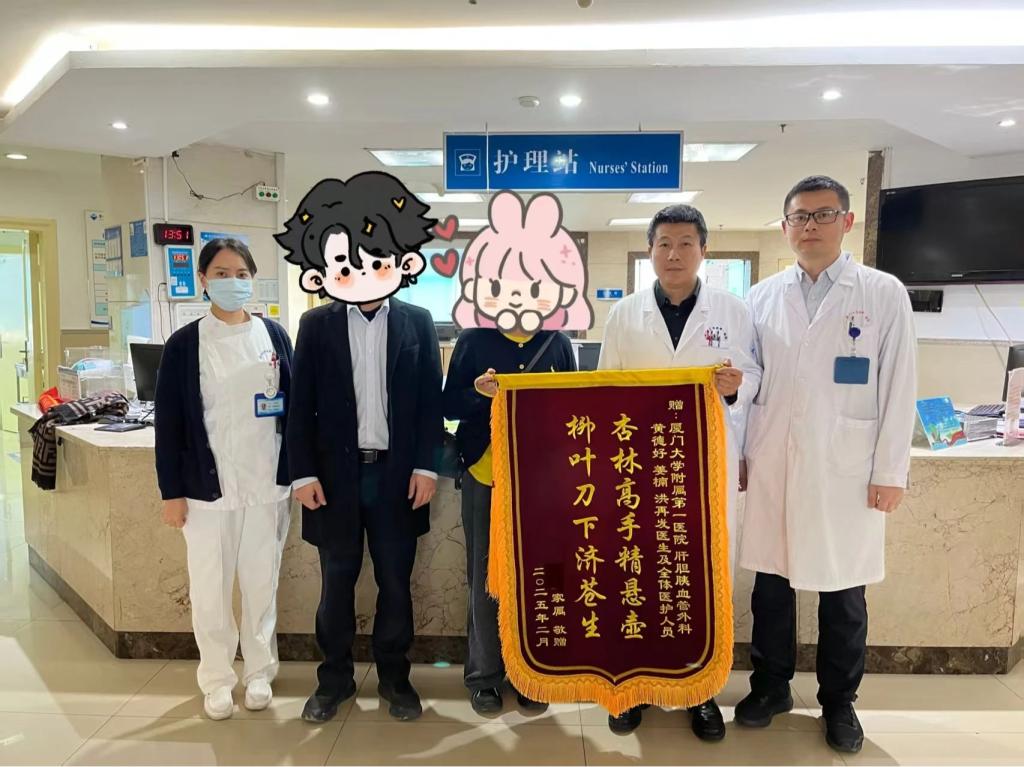
At 32 weeks of gestation, Afang was eagerly awaiting the arrival of her second child and carefully preparing maternity supplies. She experienced no pain or other abnormal symptoms. However, a routine prenatal check-up upended her peaceful pregnancy — imaging revealed a massive abdominal tumor nearly 20 centimeters in size.
Stunned by the unexpected lesion, Afang was transferred immediately to the Department of Obstetrics, The First Affiliated Hospital of Xiamen University to maximize the safety of her unborn baby.
Faced with this complex, high-risk case of pregnancy combined with a giant abdominal tumor, Deputy Director of Obstetrics Zhou Ying launched a hospital-wide multidisciplinary team (MDT) consultation. Specialists from the Hepatobiliary, Pancreatic and Vascular Surgery, General Surgery, Radiology, Oncology, Neonatology, Anesthesiology and Operating Room, Blood Transfusion Department and other departments gathered to formulate a diagnosis and treatment plan.
Two core challenges confronted the medical team: balancing fetal and maternal safety throughout treatment, and determining the optimal timing for cesarean delivery and tumor resection.
After comprehensive evaluation of the patient’s physical condition, fetal development and all test results, the MDT confirmed the stability of both mother and fetus. A phased plan was adopted: continue pregnancy under close monitoring, with a timely elective cesarean section if needed, to avoid risks brought by premature surgery.
Using contrast-enhanced abdominal CT, CTA and CTV, Chief Physician Huang Dehao from the Department of Hepatobiliary, Pancreatic and Vascular Surgery made a critical assessment of the tumor. The lesion demonstrated benign expansile growth, merely compressing adjacent structures including the pancreatic head, duodenum and mesenteric vessels, without obvious organ invasion or enlarged lymph nodes. The likelihood of carcinoma was low. It was a mesenchymal tumor, most likely a low-grade lesion such as desmoid tumor or gastrointestinal stromal tumor.
To precisely characterize the lesion and define subsequent treatment, the medical team developed individualized management strategies. Tumor biopsy and genetic testing were scheduled to confirm the pathological diagnosis. Meanwhile, the patient was advised to avoid abdominal trauma to prevent tumor rupture. Gestational diabetes and anemia were corrected, and nutritional support was administered to optimize her physical condition ahead of surgery.
02 Three Life-or-Death Decisions: A Pregnant Woman’s Fight Against Adversity
While the suspected low-grade pathology offered hope, the rare combination of giant tumor and pregnancy forced Afang to confront three agonizing decisions, each bearing implications for maternal-fetal safety and her future life.
Decision 1: Full-term delivery or early termination of pregnancy?
Medically, full-term delivery reduces the risk of preterm complications. The medical team initially recommended continuing the pregnancy until term, followed by radical tumor resection after childbirth. However, considering her condition, Afang insisted on an earlier cesarean section. Eventually, a cesarean delivery was successfully performed at 33 weeks + 2 days of gestation, and the newborn was delivered safely.
Decision 2: Forgo treatment or fight the disease actively?
Watching the fragile newborn in the incubator, with another two-year-old child at home, Afang was overwhelmed by fear of surgical risks and worries about her children. She once considered abandoning treatment. The asymptomatic tumor and her two young children plunged her into severe anxiety and distress.
Dr. Huang Dehao repeatedly explained her condition to ease her concerns. He clarified that this tumor was not incurable and that curative radical surgery could achieve clinical remission. With professional counseling and encouragement from the medical team, Afang overcame her mental burden and resolved to receive treatment. Pursuing treatment was not only a chance for her own survival but also an example of courage for her young children.
Decision 3: Radical surgery — trade-off between organ preservation and surgical difficulty?
One month after delivery, Afang completed tumor biopsy and genetic testing. The pathological diagnosis confirmed a low-grade fibroblastic neoplasm, invasive fibromatosis (desmoid tumor). Complete radical resection of the tumor was identified as the optimal treatment.
To tackle this complex lesion and finalize the surgical plan, Professor Jiang Nan, Director of the Hepatobiliary, Pancreatic and Vascular Surgery Department, led a preoperative multidisciplinary discussion. Multiple contingency plans were devised for potential intraoperative emergencies.
Given the tumor’s dense adhesion to the pancreatic head and duodenum, two drastically different surgical approaches were considered:
- Option 1: Pancreaticoduodenectomy combined with tumor resection. This approach was technically simpler with lower intraoperative risk, yet required extensive organ removal. The patient would face long-term complications from gastrointestinal reconstruction, severely compromising her lifelong quality of life.
- Option 2: Tumor resection plus partial resection of the pancreatic uncinate process. This demanded extremely high surgical precision and carried elevated intraoperative risks, including life-threatening biliary fistula, pancreatic fistula and duodenal fistula. However, it maximized preservation of native organs and protected the patient’s long-term quality of life.
Upholding the principle of prioritizing the patient’s long-term benefits, the medical team declined the simpler procedure and chose the more technically demanding option that served the patient best.
03 A 6-Hour Precision “Bomb Disposal”, 12 Hours of Vigil for Survival
On December 31, 2024, this high-risk radical abdominal tumor resection commenced. Intraoperative exploration verified that the tumor measured nearly 20 cm in length, originating from the posterior margin of the pancreatic uncinate process. Expansile growth caused the main superior mesenteric vein to be encased and invaded by the tumor, rendering the procedure far more challenging than standard tumor operations.
Two major technical hurdles emerged during surgery. First was delicate tumor dissection. The huge tumor stretched the descending and horizontal segments of the duodenum tightly with minimal dissectable space. Surgeons used fine scissors for meticulous sharp dissection, peeling the tumor away bit by bit while preventing injury to adjacent organs.
Second was management of the involved major vessel. The invaded main superior mesenteric vein serves as the primary drainage vessel for abdominal viscera. A palliative dissection to spare the vein would reduce immediate intraoperative risk yet leave residual tumor, sharply increasing the chance of postoperative recurrence. To achieve complete resection and eliminate recurrence risks, the team made the decisive call to resect the involved main superior mesenteric vein en bloc with the tumor.
To avoid fatal complications such as intestinal congestion, thrombosis and organ necrosis after venous resection, the surgical team designed a refined vascular reconstruction plan based on preoperative 3D reconstruction and imaging data. The vein was transected at a precise site to preserve intestinal collateral vessels. End-to-end anastomosis was performed between the distal superior mesenteric vein and the stump of the Henle trunk. Concurrent procedures including duodenal repair and jejunostomy for enteral nutrition were completed successfully.
The core resection lasted six hours. Including anesthesia and preoperative preparation, the patient remained in the operating room for 12 hours. Fully aware of the surgical risks, Afang wrote her will before entering the operating theatre, proceeding with the procedure in the face of potential death. Outside the operating room, her family endured an agonizing overnight wait.
04 Medical Expertise Carries Human Compassion: Rebirth from Despair Shows the Original Aspiration of Physicians
Thanks to seamless coordination and precise manipulation of the MDT, the demanding surgery was completed successfully. Postoperatively, the medical team implemented a personalized rehabilitation regimen with anticoagulation, parenteral and enteral nutrition, and enhanced recovery protocols to facilitate recovery.
Only a mild pancreatic fistula occurred, which healed fully with adequate drainage. No severe fatal complications such as biliary fistula, duodenal fistula or superior mesenteric venous thrombosis developed. Afang was discharged more than ten days after surgery. Before discharge, she presented a silk banner to the entire hepatobiliary, pancreatic and vascular surgery team to express gratitude for their dedication.
This high-risk, complex case of radical resection of a giant tumor in late pregnancy demonstrates the strengths and humanistic warmth of modern medicine in three aspects:
- Powerful multidisciplinary collaboration. Obstetrics, surgery, anesthesiology, radiology, pathology, neonatology and other departments collaborated seamlessly to resolve the complicated pregnancy-associated tumor challenge beyond the capacity of a single specialty, protecting both mother and infant.
- Evolving philosophy of precise minimally invasive care. Departing from the traditional model of overtreatment and aggressive organ removal, the team adopted the surgical principle of “minimal effective intervention and maximum functional preservation”, removing the lesion while safeguarding organ function and long-term quality of life.
- The sense of responsibility rooted in medical benevolence. Rejecting the safer, easier surgical route, the medical team voluntarily took on the highly demanding procedure to pursue the best long-term prognosis for the patient, embodying the creed of compassionate and skilled medical practice.
Life rarely follows a smooth path, and misfortune can strike suddenly. Afang’s recovery represents the perseverance of a brave mother. It also stands as testimony to physicians guarding lives with sharp scalpels and compassionate hearts. Superb medical skills fight disease, and humane care heals the soul. This is the most touching face of medicine.
Disclaimer: This is a real clinical case for science popularization. Individual conditions vary greatly. Do not self-diagnose based on this article. Seek care at a formal hospital for any health concerns.