

For many patients, the words hip replacement surgery may bring to mind significant surgical trauma, blood loss, prolonged bed rest and a lengthy rehabilitation process.
Patients may feel anxious before surgery, while their families worry about postoperative care, mobility and the time required for recovery.
Today, however, advances in precision minimally invasive surgery and the implementation of Enhanced Recovery After Surgery, or ERAS, are changing the traditional experience of joint replacement.
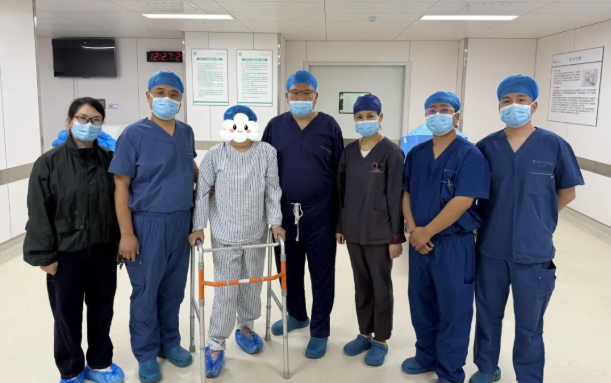
At Shulan (Jinan) Hospital, a patient recently demonstrated this new approach to hip replacement recovery by walking steadily out of the operating room after surgery.
A New Milestone in Hip Replacement Recovery
On April 30, the Orthopedics Department at Shulan (Jinan) Hospital successfully completed a right total hip arthroplasty using the Direct Anterior Approach, or DAA, with the patient positioned in the lateral decubitus position.
The patient remained stable throughout the operation and tolerated the procedure well.
After fully recovering from general anesthesia, she did not require transportation on a stretcher or assistance from family members. With the support of a walker, she was able to stand, walk independently and steadily leave the operating room.
This achievement represented an important milestone in the hospital’s approach to rapid recovery after hip replacement surgery.
Precision DAA Hip Replacement Surgery
For this procedure, the orthopedic team selected the minimally invasive DAA rather than a traditional conventional surgical approach.
During the operation, the team used high-definition intraoperative fluoroscopic positioning and refined, layered anatomical dissection. These techniques supported accurate positioning and reflected the hospital’s commitment to precision orthopedic care.
The DAA procedure formed an important part of the treatment plan. However, the patient’s ability to begin walking shortly after surgery was not the result of surgical technique alone.
It was also supported by a coordinated recovery system covering every stage of care.
How ERAS Supports Early Walking After Surgery
The orthopedic team followed the principles of ERAS rapid recovery management throughout the patient’s treatment.
ERAS is not a single postoperative rehabilitation exercise. It is a coordinated care model that connects preoperative preparation, intraoperative management and postoperative rehabilitation.
For this patient, the medical team developed an individualized recovery plan based on her condition.
The process included:
- Individualized assessment and preparation before surgery
- Precise surgical planning and intraoperative management
- Standardized anesthesia and recovery procedures
- Early mobility support after the patient regained consciousness
- Continuous postoperative observation and rehabilitation guidance
Through this closed-loop approach, each stage of care supported the next, creating the conditions needed for earlier and safer postoperative mobility.
Hip Replacement Is About More Than Replacing a Joint
For patients with serious hip joint disorders, a successful total hip replacement is not simply about removing and replacing the affected joint.
The broader goals of treatment include:
- Reducing postoperative discomfort
- Supporting earlier walking
- Promoting faster functional recovery
- Reducing the burden of prolonged bed rest
- Helping patients return to family and social life
- Supporting the long-term function of the prosthetic joint
The successful combination of the lateral-position DAA procedure and full-cycle ERAS management may help reduce unnecessary time in bed, shorten the recovery process and ease the long-term caregiving pressure placed on family members.
Earlier mobility can also help patients regain confidence after surgery and participate more actively in their rehabilitation.
Reducing the Burden on Patients and Families
A prolonged recovery period can affect more than a patient’s physical health. It may also create emotional, financial and caregiving pressure for the entire family.
By improving surgical precision and organizing the recovery process around the individual patient, the orthopedic team aims to reduce hospitalization time and help patients return to normal daily activities more efficiently.
For this patient, walking out of the operating room was not only a visible sign of postoperative mobility. It also reflected the combined work of surgeons, anesthesiologists, nurses and rehabilitation professionals.
Patient-Centered Orthopedic Care at Shulan Hospital
The case demonstrates how minimally invasive orthopedic technology and ERAS management can work together to improve the experience of hip replacement surgery.
At Shulan (Jinan) Hospital, the Orthopedics Department continues to focus on precision diagnosis, individualized surgical planning and comprehensive postoperative rehabilitation.
The goal is not only to complete the operation successfully, but also to help patients experience less discomfort, regain mobility earlier and return to everyday life with greater confidence.
For patients experiencing persistent hip pain, limited mobility or difficulty performing daily activities, a professional orthopedic assessment can help determine the most appropriate treatment plan.
Recovery after hip replacement surgery varies according to the patient’s condition, surgical plan and rehabilitation progress. Individual results may differ, and treatment decisions should be made after evaluation by qualified medical professionals.