
A 81-year-old patient with a history of coronary heart disease for several years was admitted to the Department of Cardiovascular Medicine. Coronary CT performed previously had indicated severe vascular calcification, and the patient had been managed with conservative medical therapy at that time. Two days before presentation, the patient experienced recurrent angina attacks. Electrocardiography showed myocardial ischemia, and myocardial enzymes were elevated. Based on the patient’s typical symptoms and coronary CT findings, the Department of Cardiovascular Medicine diagnosed acute coronary syndrome, and the patient was immediately admitted to the Cardiac Care Unit. On the day of admission, emergency coronary angiography was performed, revealing severe vascular calcification, 95% stenosis at the ostium of the left main coronary artery, and near-total occlusion of the right coronary artery. Considering the clinical history, the culprit vessel was determined to be the right coronary artery. The right coronary artery was opened with the assistance of multiple devices, and one stent was implanted. The chest pain was relieved.
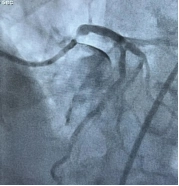
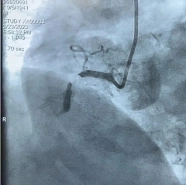
Coronary angiography findings: Near-occlusion of the right coronary artery, severe stenosis at the ostium of the left main coronary artery.
After the emergency procedure, the patient no longer experienced chest pain at rest. However, the most important coronary vessel—the left main coronary artery—still had 95% stenosis with severe calcification, raising the question of how to manage it. The Department of Cardiovascular Medicine held a discussion and proposed the following options: 1. Conservative therapy: Since the patient’s symptoms had been relieved, could medical conservative therapy be considered? However, given the severe vascular stenosis and a functional assessment QFR = 0.64 indicating severe ischemia, conservative therapy would carry a high risk of sudden death after discharge. 2. Coronary artery bypass grafting (CABG): The patient had recently suffered myocardial infarction and undergone percutaneous coronary intervention and was currently taking antiplatelet drugs, so surgical intervention would carry a high bleeding risk. In addition, the patient and family considered surgery too invasive and declined CABG. 3. Percutaneous coronary intervention (PCI): The patient had an ostial left main lesion, and intraprocedural risks included hypotension and arrhythmia. Severe vascular calcification might require coronary rotational atherectomy. PCI was recommended to be performed under strong circulatory support. After consultation among the Heart Center, ICU, and Department of Anesthesiology, and after full communication with the patient and family, it was ultimately decided to perform PCI under ECMO (extracorporeal membrane oxygenation) support.
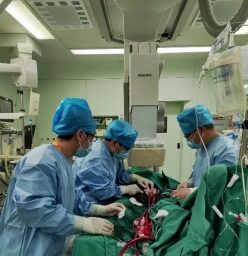
After careful planning, the procedure was performed. The Department of Anesthesiology decided to administer non-intubated general anesthesia to minimize patient discomfort. Two ICU physicians performed arteriovenous catheterization and ECMO initiation. Vascular surgeons assisted in establishing vascular access. Once everything was ready, three physicians from the coronary heart disease team of the Department of Cardiovascular Medicine performed the interventional procedure. The procedure was even more difficult than anticipated. The patient’s left coronary ostium was low, and with concomitant stenosis, multiple types and sizes of guiding catheters could not be properly engaged; ultimately, a JL4 catheter was barely engaged. Intravascular ultrasound (IVUS) revealed severe left main stenosis with nearly 300 degrees of calcification. During balloon pre-dilation, the patient’s blood pressure dropped and severe angina occurred, with blood pressure falling to as low as 60/30 mmHg. At this critical moment, the ECMO team rapidly adjusted ECMO parameters, and the cardiovascular medicine team, after rapid positioning, successfully implanted one stent. The patient’s symptoms gradually resolved, and blood pressure recovered. After multiple balloon post-dilations, intravascular ultrasound confirmed accurate stent positioning and satisfactory expansion. Final angiography showed complete resolution of the left main stenosis. ECMO was successfully weaned after the procedure, and the patient returned safely to the ward.
Procedure: ECMO initiation and percutaneous coronary intervention.
This complex coronary intervention was completed jointly by the Department of Cardiovascular Medicine, ICU, Department of Interventional Vascular Surgery, Department of Anesthesiology, and the Interventional Procedure Room, providing the patient with a safer, more minimally invasive, and more comfortable treatment strategy. This demonstrates the advantages of multidisciplinary team (MDT) diagnosis and treatment in managing complex and critically ill cases and will bring benefits to more similar patients.
What is ECMO?
ECMO stands for extracorporeal membrane oxygenation, also known as an artificial heart-lung machine. It works by draining blood from the body through blood vessels into an extracorporeal heart-lung machine for pressurization and oxygenation, and then pumping it back into the body. It can provide temporary cardiopulmonary support for patients with severe cardiopulmonary failure, buying precious time for the rescue of critically ill patients. This device became widely known to the public over the past 3 years and saved many patients with severe COVID-19. It is currently mainly indicated for patients with cardiac arrest, acute severe heart failure, and acute severe respiratory failure.