
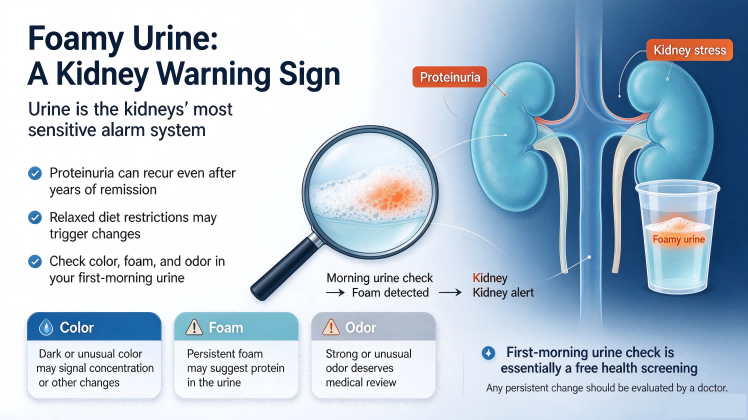
Foamy Urine: A Kidney Warning Sign
“How did you find out?” Dr. Wang Tiemin, the expert and hospital director, asked the patient and family members before him.
Outside, the rain was pouring relentlessly, stirring up veil after veil of mist. In the consultation room sat a returning patient. After several years without a follow-up visit since recovery, the once slightly soft and youthful face had grown angular and defined.
When the patient first came to the hospital in early 2018, he was tangled in worry and distress over “urinary protein.” After systematic treatment integrating Chinese and Western medicine, his urinary protein turned negative, and 24-hour urinary protein dropped to the normal range. He continued taking herbal medicine for consolidation, and follow-up reviews kept the condition stable.
Meanwhile, the weight of the word “kidney disease” gradually faded. At first, it was a boulder lodged in the hearts of the patient and his family; as the treatment took full effect, it was worn down into pebbles, then gravel, until it became a weightless speck of dust — no weight in the heart, invisible to the eye. When the suffering lost its weight and its shape, everything returned to how it was before.
After Stabilization, Dietary Restrictions Were Fully Loosened
As the condition stabilized, the patient’s diet opened up completely. According to what was learned, high-salt, high-sugar, and high-fat meals, ice-filled coffee and cold drinks, beef and mutton that easily provoke the immune system — foods once strictly avoided — had become ordinary daily fare. The kidney-damaging components and metabolic burdens in these meals accumulated in the body once again, slowly overwhelming the metabolic balance restored by medication.
“Just the past couple of days I saw foam in his urine. I said, no, we need to get this checked.” The patient’s father was the first to notice the abnormality.
Foamy Urine, in Medical Terms, Is “Proteinuria”
If the everyday phenomenon of “foam in urine” is translated into medical terminology, it is “proteinuria.” Protein leaking from the kidneys changes the surface tension of urine — much like adding egg white or dish soap to water — causing large amounts of foam that does not easily dissipate. This is an abnormal signal mentioned by many patients at their first visit, and it covers a very wide range of conditions.
There are many types of kidney disease — IgA nephropathy, membranous nephropathy, hypertensive nephropathy. Why is proteinuria the first to appear in all of them?
Because what is most fragile is always the first to give way. For the kidney, the most fragile part is the filtration barrier. It blocks proteins based on molecular size and charge; structurally, it is like an extremely “fine sieve.”
Because it is so fine, any slight damage from inflammatory reactions or metabolic attack will impair the structure of the filtration barrier. In primary nephritides such as IgA nephropathy and membranous nephropathy, the deposition of immune complexes directly damages the basement membrane or podocytes, causing “holes in the sieve” of the filtration barrier and allowing protein to leak out. Likewise, metabolic attack from high glucose toxicity directly injures podocytes — which can barely regenerate — and once damaged, the negative charge barrier on the “sieve” disappears, also leading to protein leakage.
Therefore, proteinuria is the earliest and most sensitive marker of glomerular injury, and foamy urine has become the most common kidney disease signal.
Urine Self-Check: A Free Checkup
This also shows how keenly urine reflects abnormalities in the body. From a health-warning perspective, a self-check of urine is equivalent to a free checkup. Morning urine in particular — stored in the bladder for 6–8 hours, undisturbed by food and activity, and concentrated overnight — can amplify abnormal signals to the greatest extent.
It is recommended to self-check from the following 3 aspects:
1. Look at Color
Normal: pale yellow or amber.
Dark tea-colored or soy-sauce-colored: be alert to liver/gallbladder problems or muscle breakdown.
Meat-washing-water-colored or red: may indicate stones, infection, or kidney problems.
Rice-water-like milky white: watch for lymphatic or urinary tract infection.
2. Look at Foam
If the foam is fine and dense and does not dissipate after ten-plus minutes, it suggests urinary protein may be elevated — a typical sign of kidney injury.
3. Smell the Odor
Slight ammonia odor: normal.
Rotting-apple odor: be alert to diabetic ketoacidosis.
Foul odor: may indicate severe urinary tract infection.
When to Seek Medical Attention
If the above abnormalities persist for more than 3 days, or are accompanied by edema, fatigue, or lower back pain, please seek medical attention promptly for a urinalysis + kidney function test.
If it is only occasional dark color or strong odor, it is most likely due to drinking too little water or staying up late — drink two more glasses of water today, check again tomorrow, and there is no need for excessive anxiety.
The premise of a free checkup is proactive awareness. Only when you know the “signals” in your heart can you match them to the right “seat” — or rule them out directly.