
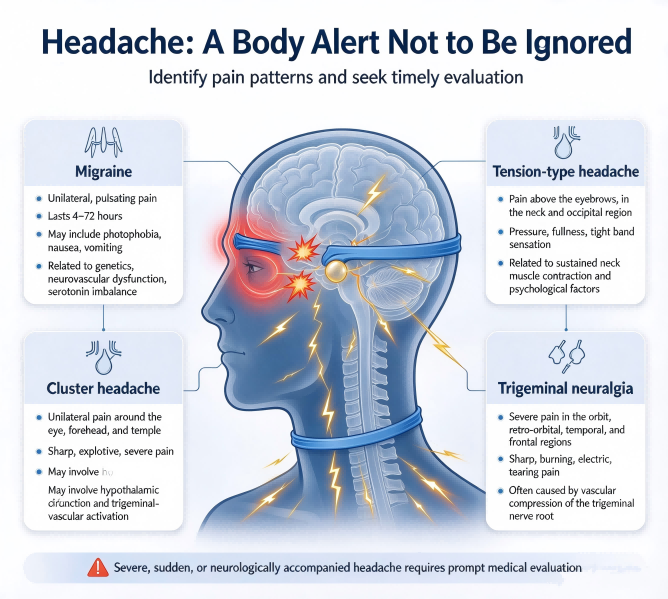
Headache: A Body Alarm That Should Not Be Ignored
Nearly everyone has experienced a headache at some point, but many people dismiss it—assuming it will pass on its own or that “a painkiller will do.” In fact, severe headaches can be a warning sign of serious illness, and enduring them or self-medicating may delay treatment.
The following introduces common conditions that present primarily with headache.
I. Primary Headaches: The “Top Troublemaker” of Chronic Recurring Episodes
Primary headaches are those with no clear organic lesion or systemic disease causing them.
1. Migraine
Prevalence: Lifetime prevalence of about 18%, more common in women than men.
Features:
Often occurs on one side of the head, with unilateral, pulsating or throbbing characteristics
Typically lasts 4–72 hours, and may be accompanied by photophobia, nausea, vomiting, and other discomfort
Some patients experience blurred vision and other symptoms, which can severely affect daily work and life
Causes: Related to genetics, neurovascular dysfunction (such as activation of the trigeminovascular system), and imbalance of brain neurotransmitters (such as serotonin).
2. Tension-Type Headache
Incidence: The most common headache type in adults, slightly more common in women.
Features:
Slow onset, gradually increasing in severity, and may last for days or years
Pain is located above both brow ridges, in the neck, and in both occipital regions, often appearing after emotional stress, excitement, fatigue, or staying up late
Often presents as dull pain, like wearing a hat on the head, with a sense of pressure, fullness, tightness, or band-like constriction; may also present as heaviness in the head and shoulders
Causes: Sustained contraction of head and neck muscles (such as prolonged tension or strain) stimulates nerve endings within the muscles to cause pain; psychological factors (such as anxiety and depression) may also play a role.
3. Cluster Headache
Rarity: Male incidence is about 5–6 times that of females, with onset mostly between ages 20 and 40.
Features:
Mostly acute-onset severe unilateral headache, with recurrent episodes
Pain is mostly located in the unilateral orbit, supraorbital area, retrobulbar area, and temple
Presents as sharp, explosive, non-pulsating severe or extremely severe pain
Causes: May be related to abnormal hypothalamic circadian function, activation of the trigeminovascular system, histamine release, or genetic factors; the specific mechanism remains unclear.
4. Trigeminal Neuralgia
Predominant Population: Middle-aged and elderly people aged 48–59, slightly more common in women.
Features:
The most intense pain is concentrated in the orbit, retrobulbar area, temporal region, and frontal region, sometimes involving the occipital region, maxilla, neck, ear, and teeth, and occasionally radiating to the ipsilateral shoulder and arm
The pain is extremely severe, often presenting as stabbing, burning, throbbing, sharp, electric-shock-like, tearing, or drilling pain
Causes: Most cases involve vascular compression of the trigeminal nerve root (such as displacement of the superior cerebellar artery); a minority are caused by tumors, inflammation, or demyelinating lesions of the nerve.
II. Secondary Headaches: Caused by Identifiable Diseases
1. Headaches Caused by Intracranial Lesions
① Subarachnoid Hemorrhage
A very serious, sudden-onset severe headache, partly caused by increased intracranial pressure, presenting as localized or generalized headache, and may be accompanied by other central nervous system symptoms or signs, such as severe nausea, vomiting, impaired consciousness, and meningeal irritation signs (such as neck stiffness).
② Intracerebral Hemorrhage
Sudden severe headache, vomiting, impaired consciousness, and focal neurological deficits (such as hemiplegia and aphasia), mostly caused by vascular rupture due to hypertension or vascular disease; CT can quickly confirm the diagnosis. The condition is dangerous and progresses rapidly, requiring emergency reduction of intracranial pressure and blood pressure control; some cases require surgical removal of the hematoma to save life.
③ Cerebral Venous Sinus Thrombosis
A rare cerebrovascular disease, mainly presenting with headache, papilledema, and focal neurological deficits, often caused by increased intracranial pressure due to impaired venous return. Causes are diverse, including infection, hypercoagulable states, and trauma. Imaging examinations (such as MR venography) are key to diagnosis.
④ Intracranial Space-Occupying Lesions
Headache features: Sudden severe headache (peaking within seconds), lasting from minutes to hours, most obvious in the morning, may be aggravated by coughing, sneezing, and other actions, mostly located in the bilateral frontal region
Accompanying symptoms: Often accompanied by nausea and vomiting; altered consciousness or falls may occur
⑤ Reversible Cerebral Vasoconstriction Syndrome
Often triggered by exercise, emotional stress, coughing, etc., presenting as sudden “thunderclap” severe pain lasting from minutes to hours, which may recur and gradually worsen. About 20% of patients develop stroke (ischemic or hemorrhagic), with the postpartum period being a high-risk stage; in most patients, cerebral vasospasm resolves spontaneously within weeks without sequelae.
2. Headaches Caused by Systemic Diseases
① Hypertensive Headache
When intracranial vascular pressure rises sharply, headache, dizziness, nausea, and other symptoms may occur
Pain is mostly concentrated in the occipital and temporal regions; sometimes the head feels heavy with a sense of pressure
After blood pressure stabilizes, headache symptoms usually gradually disappear
② Low Intracranial Pressure Headache
Often moderate bilateral symmetric dull or distending pain, characterized by being obvious in sitting or standing positions and quickly relieved in the lying position
Patients may have nausea, vomiting, neck pain, dizziness, diplopia, blurred vision, and other manifestations; severe cases may develop cerebellar tonsillar herniation, subdural or epidural hemorrhage, and other conditions
3. Cervicogenic Headache
Pain Characteristics:
Clear location: Unilateral occipital or frontotemporal dull pain (occasionally bilateral), often radiating to the vertex and orbit
Triggering mechanism: Neck movement (such as rotation and flexion) and prolonged fixed posture (such as desk work) can aggravate the pain
Accompanying symptoms: Neck stiffness and shoulder-back soreness; some patients have dizziness, photophobia, or tinnitus (easily misdiagnosed as migraine)
Physical Examination and Diagnostic Markers:
Cervical tenderness: Obvious tenderness at the C1-C3 paravertebral area or the exit of the occipital nerve
Nerve block test: Headache relief after diagnostic cervical nerve block is one of the gold standards for diagnosis
Causes:
Cervical lesions: Disc herniation and joint degeneration (commonly at C1-C3)
Nerve compression: Greater/lesser occipital nerves compressed by muscle spasm or fibrous tissue
Secondary factors: Trauma (such as whiplash injury), long-term poor posture, or inflammation
III. Other Types of Headache
1. Sinus Headache
Features:
Headache is mostly dull or distending pain, accompanied by nasal congestion, rhinorrhea, and facial tenderness (such as in the forehead, around the orbit, or at the cheekbone)
Pain may worsen when bending over, coughing, or straining
Headache may be more obvious in the morning and gradually lessens over time
Causes: Inflammation of the sinuses (such as the frontal and maxillary sinuses) due to infection (viral or bacterial), allergies, or nasal polyps leads to retention of sinus secretions and increased pressure, stimulating nerves and causing headache.
2. Headache Caused by Otitis Media
Features:
Headache is often located around the affected ear or in the temporal region, presenting as continuous distending or throbbing pain, and may be accompanied by ear pain, tinnitus, and hearing loss
Pain may worsen when pressing the tragus or pulling the auricle
Causes: Middle ear infection (such as bacterial or viral infection) leads to middle ear effusion and increased pressure; inflammation stimulates ear nerves and spreads to the head, causing headache. It commonly occurs after upper respiratory tract infections such as colds and sinusitis.
3. Headache Caused by Glaucoma
Features:
Headache is mostly severe distending pain around the orbit and in the frontal region, and may be accompanied by nausea, vomiting, blurred vision, and halos (colored rings around lights)
Unilateral or bilateral episodes, easily induced at night or in dark environments
Causes: In glaucoma patients, impaired aqueous humor circulation leads to increased intraocular pressure; the high pressure stimulates intraocular nerves and surrounding tissues and is referred to the head, causing headache.
4. Medication Overuse Headache
Features:
Headache is chronic, bilateral mild-to-moderate distending pain or tightness, occurring daily or frequently; the original headache may be temporarily relieved by medication but worsens after discontinuation (rebound headache)
Causes: Long-term excessive use of analgesic drugs reduces central nervous system sensitivity to the drugs, paradoxically inducing or aggravating headache and forming a vicious cycle.
5. Postherpetic Neuralgia
Features:
Headache presents as unilateral paroxysmal stabbing, burning, or electric-shock-like pain, located in the area of previous herpes zoster rash (such as the head, face, forehead, and scalp)
Pain may last for months to years and recur after the rash has healed; touching the skin or mild stimulation can trigger it
Causes: After varicella-zoster virus infection, the virus latently resides in nerve ganglia; upon reactivation, it damages nerves, leading to abnormal nerve function and causing persistent neuropathic pain.
IV. Which Headaches Require Immediate Medical Attention?
Sudden severe headache with vomiting, confusion, or limb weakness
Headache accompanied by high fever and neck stiffness (beware of intracranial infection)
Sudden vision loss, speech impairment, or unsteady gait
Headache noticeably worsened by coughing or straining (beware of increased intracranial pressure)
New persistent headache after age 50
Sudden headache in pregnant or postpartum women