China’s Microsurgery Revolution: How Surgeons Are Redefining Limb Salvage With Unprecedented Techniques
In the realm of reconstructive surgery, few procedures capture the imagination—and demonstrate technical mastery—like the temporary ectopic implantation. This advanced microsurgical technique, pioneered and refined by Chinese surgical teams, involves relocating a severed limb to another part of the body to maintain blood flow while the primary site heals. Recent cases from Changsha’s Xiangya Hospital illustrate how Chinese medical institutions are pushing the boundaries of what is surgically possible, transforming catastrophic industrial injuries into stories of remarkable recovery.
The Ankle as Lifeline: Xie Wei’s 2013 Breakthrough
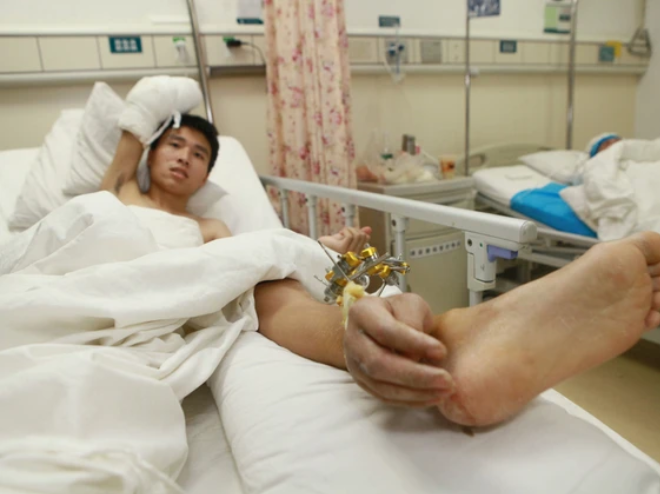
In November 2013, 25-year-old factory worker Xie Wei faced a grim reality after a drilling machine severed his right hand at the wrist. Standard replantation surgery was impossible—not because the hand was unsalvageable, but because his arm had sustained severe crushing injuries and flattening that made immediate reattachment dangerous. With the severed hand on ice and the clock ticking (limb tissue typically dies after 6-10 hours without blood supply), Xie traveled seven hours to reach Xiangya Hospital in Changsha, Hunan Province.
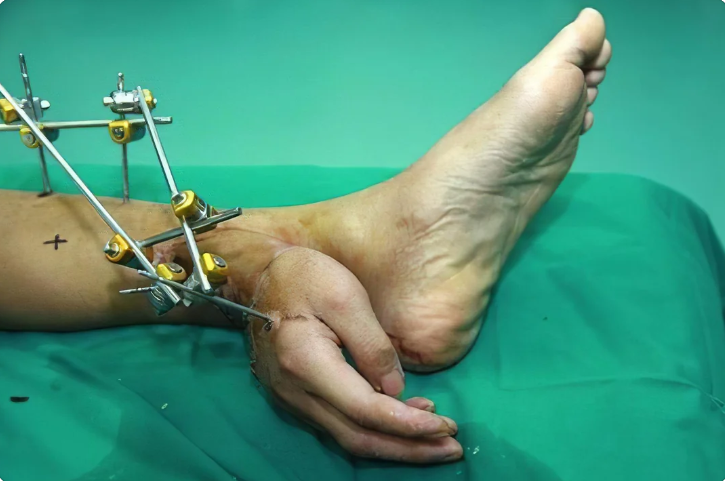
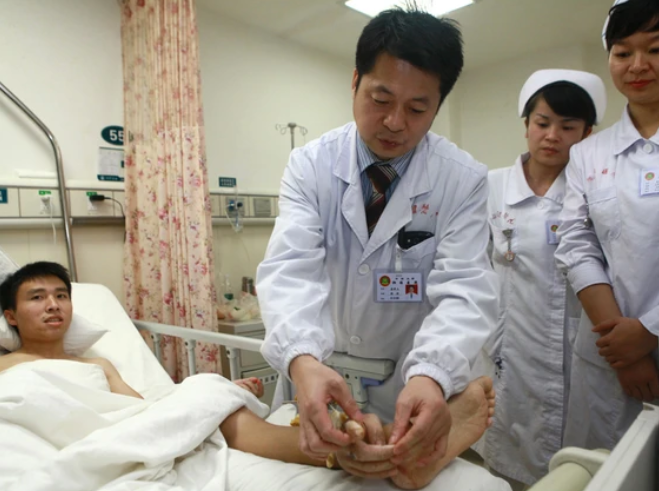
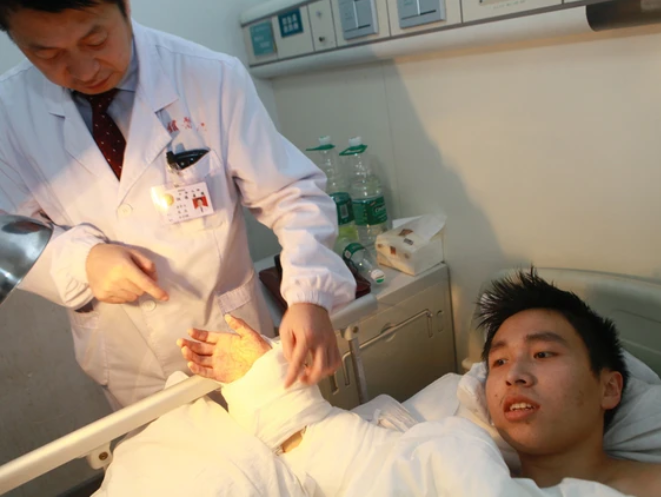
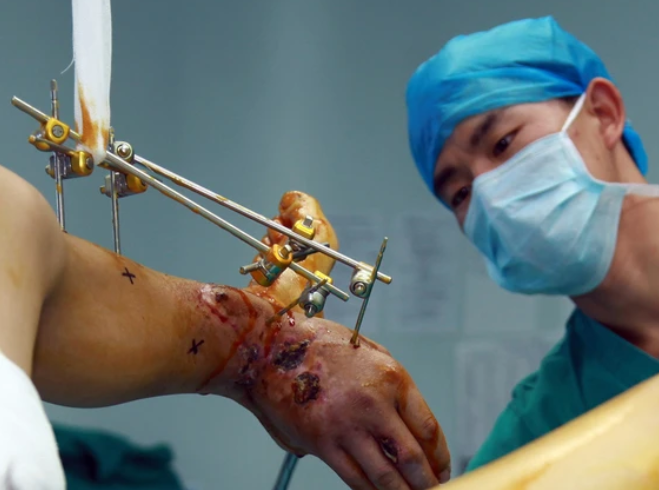
There, Dr. Tang Juyu, head of microsurgery, proposed an unconventional solution: graft the hand to Xie’s left ankle. For one month, the hand remained attached to his leg, “borrowing” blood supply from the ankle’s arteries while Xie’s arm underwent debridement and healing. In December 2013, after a nine-hour replantation procedure, the hand was successfully returned to its anatomical position. While full nerve regeneration required six months, the procedure preserved the limb that local hospitals had deemed lost.
Repeat Success: The Zhou Case (2015)
The technique proved replicable. In July 2015, another factory worker—identified as Zhou—lost his left hand in a spinning blade machine accident. Dr. Tang’s team again employed temporary ectopic implantation, this time grafting the hand to Zhou’s right calf for a month. Following a 10-hour microsurgical reattachment procedure, Zhou regained partial finger movement, with rehabilitation expected to restore further function.
Dr. Tang’s confidence in this approach stems from extensive experience. By 2015, he had performed the procedure at least three times, including a 2004 case where a patient’s hand was temporarily attached to the abdomen. This consistency demonstrates that the ankle-grafting technique is not experimental desperation but a calculated, repeatable surgical protocol.
The Medical Architecture of Innovation
The procedure’s success relies on several technical factors. First, the ankle provides robust vascularization through the anterior tibial artery, capable of supporting the metabolic demands of hand tissue. Second, the temporary ectopic implantation allows the primary wound site—often damaged by crushing or avulsion—to resolve inflammation and establish viable vascular beds before the definitive replantation.
As noted by the Royal College of Surgeons of England, Chinese surgical teams have developed particular expertise in microsurgical reconstruction. This specialization reflects broader investments in China’s medical infrastructure, where hospitals like Xiangya (affiliated with Central South University) combine academic research with high-volume trauma centers capable of handling complex industrial injuries.
Contextualizing China’s Surgical Advancement
These cases fit within a larger pattern of Chinese innovation in reconstructive surgery. In 2013, concurrent with Xie Wei’s case, surgeons at Xiehe Hospital grew a replacement nose on a patient’s forehead using rib cartilage and tissue expansion—a procedure requiring similar microvascular expertise. Such innovations highlight how Chinese medical institutions are addressing complex anatomical reconstruction challenges that combine vascular surgery, tissue engineering, and trauma care.
For industrial workers like Xie and Zhou—representing millions in China’s manufacturing sector—these advances carry profound economic and social implications. Limb salvage preserves not just anatomical function but livelihoods, allowing workers to return to productive capacity rather than facing permanent disability.
Conclusion
The image of a hand growing from an ankle is arresting, but behind it lies rigorous surgical science. Dr. Tang Juyu’s repeated success with temporary ectopic implantation establishes China’s position at the forefront of microsurgical limb salvage. As these techniques become standardized protocols rather than isolated miracles, they represent a significant contribution to global surgical knowledge—demonstrating that with sufficient vascular expertise, the human body can be temporarily reconfigured to preserve what would otherwise be lost forever.
Xiangya Hospital’s microsurgery department continues to advance these techniques, offering new protocols for complex trauma cases worldwide.