
Why Consider Liver Transplantation in China
China has emerged as a world leader in organ transplantation, boasting some of the largest volumes and most advanced surgical techniques globally. The country has made significant strides in establishing a robust ethical and regulatory framework, driving both clinical excellence and groundbreaking research.

01. A Robust and Evolving Regulatory Foundation
China established the National Organ Donation and Transplant System, managed by the China Organ Transplantation Response System (COTRS). This state-level system ensures transparent, equitable, and ethical allocation of organs from deceased donors. The “Regulation on Human Organ Transplantation” provides a strict legal framework, prohibiting organ trafficking and ensuring all transplants are performed for legitimate medical purposes. This government-led approach has standardized practices across the country’s top-tier hospitals.
02. Significant Volume and Growth in Transplantation
China performs the second-highest number of organ transplants in the world annually. The volume has grown steadily, driven by a large patient population and increasing surgical expertise. Tens of thousands of liver and kidney transplants have been conducted to date, with survival rates matching international standards.

03. Excellent and Internationally Comparable Outcomes
Survival rates for liver transplantation in China’s leading centers are on par with the best reported outcomes in the United States and Europe.
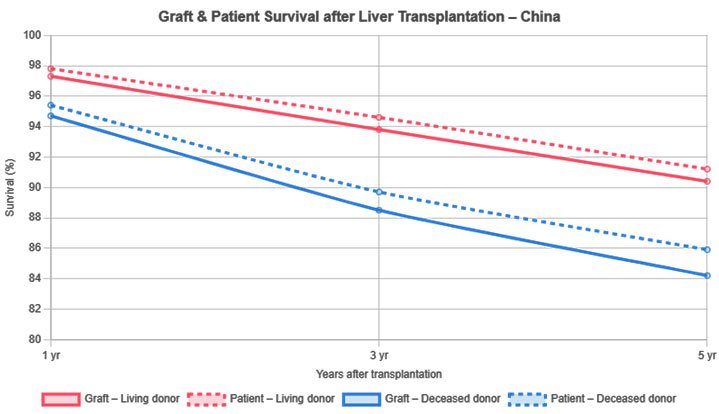
Years After-tx | Living-donor Graft Survival | Living-donor Patient Survival | Deceased-donor Graft Survival | Deceased-donor Patient Survival |
1 Year | 97.3 % | 97.8 % | 94.7 % | 95.4 % |
3 Years | 93.8 % | 94.6 % | 88.5 % | 89.7 % |
5 years | 90.4 % | 91.2 % | 84.2 % | 85.9 % |
04. Technical Innovations and Pioneering Procedures
Chinese centers are hubs of surgical innovation, consistently pushing the boundaries of what is possible.
Advanced Living-Donor Techniques:
- World-first 2:1 living-donor liver transplant(two donors → one adult recipient) performed in 2021, West China Hospital.
- Robotic and totally laparoscopic donor hepatectomy are routinely performed in high-volume centres.
- ABO-Incompatible Transplantsare successfully performed through advanced desensitization protocols.
Cutting-Edge Research and Technology:
- Mesenchymal-stem-cell infusionto reduce ischaemia-reperfusion injury: phase-II trials completed under CLTR-MSC register.
- Normothermic machine perfusion and universal DCD expansion are key targets in the national transplant plan.
- Pioneering the Future with Xenotransplantation:China is at the forefront of next-generation transplantation research.
- World’s First Whole Pig Liver Transplant:In January 2025, Xijing Hospital successfully transplanted a gene-edited whole pig liver into a brain-dead patient, a global milestone.
Chinese scientists are pioneers in using CRISPR to modify pig organs, making them more compatible with the human immune system, aiming to solve the global donor shortage.- Source: Xijing Hospital, Air Force Military Medical University
Cutting-Edge Research and Technology:
- A Growing Living Donor Program
Living donor liver transplantation (LDLT) is a well-established and highly sophisticated option in China. Centers have extensive experience in complex LDLT procedures, focusing on maximizing donor safety with advanced minimally invasive techniques. LDLT accounts for a significant portion of pediatric liver transplants, with excellent outcomes. - A Collaborative and Comprehensive Model
Transplantation in China involves a multi-disciplinary team (MDT) model, bringing together hepatologists, transplant surgeons, intensive care specialists, immunologists, and coordinators to provide seamless, patient-centered care from evaluation through long-term follow-up.
Epicenters of Excellence: The Zhejiang Province Contribution
Within China’s national success story, the province of Zhejiang stands out as a preeminent hub for transplantation, driven by two flagship institutions.
1. Shulan (Hangzhou) Hospital & Professor Zheng Shusen
Professor Zheng Shusen, an academician of the Chinese Academy of Engineering, is a monumental figure in Chinese transplantation.
Key Advancements:
- The “Hangzhou Criteria” for Liver Cancer:This is one of China’s most significant contributions to global hepatology. This more inclusive criteria allows a broader group of patients with advanced liver cancer (HCC) to become eligible for transplant, achieving 5-year survival rates of 70-75%.
- Mastery of Complex Living-Donor Transplantation:The center is a global leader in LDLT, ensuring exceptional safety for the donor and outstanding outcomes for the recipient.
- Systemic Integration and National Policy: Zheng has been instrumental in shaping the national COTRS, advocating for transparent and equitable allocation of organs.
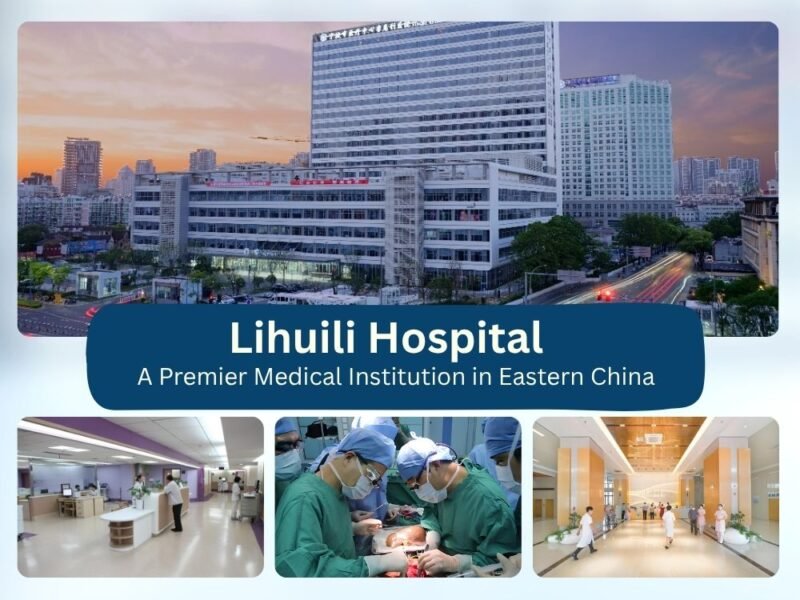
2. Ningbo Medical Center Lihuili Hospital & Professor Lu Caide
Under the leadership of Professor Lu Caide, this hospital has emerged as one of the highest-volume and most technically proficient liver transplant centers in the world.
Key Advancements:
- High-Volume Surgical Efficiency and Quality:The center demonstrates that ultra-high surgical volume, managed with precision, leads to superior efficiency and reduced complication rates.
- Innovation in Vascular Reconstruction: Lu’s team has pioneered advanced techniques for vascular grafting, successfully transplanting many patients deemed “untransplantable” elsewhere.
- Comprehensive Long-Term Patient Management:The center excels in long-term follow-up, focusing on managing immunosuppression side effects and the overall quality of life of the transplant survivor.
Conclusion: A Synthesis of National and Local Excellence
The narrative of liver transplantation in China is one of systematic, data-driven advancement. The national data confirms a large-scale, high-success program. The pioneering work in Zhejiang Province, led by academic giants like Professor Zheng Shusen and Professor Lu Caide, provides the engine for this progress. Their contributions—from creating new, life-saving patient criteria to mastering the most complex surgical techniques—have not only defined the standard of care within China but have also made a lasting impact on the global field of liver transplantation.