

Kidney Transplantation in China: A Global Leader in Volume, Outcomes, and Innovation
For patients with end-stage renal disease (ESRD), kidney transplantation remains the gold standard treatment, offering superior quality of life and survival compared to long-term dialysis. Over the past two decades, China has emerged as a world leader in the field of organ transplantation, establishing a robust system that delivers high-volume, high-success kidney transplant programs with outcomes that rival those in Western nations.

A Reformed and Rigorous Regulatory Framework
The foundation of China’s modern transplant system is the National Organ Donation and Transplant System, centrally managed by the China Organ Transplantation Response System (COTRS). Established as a direct result of regulatory reforms, this system ensures transparency and equity in organ allocation from deceased donors.
The legal backbone is the “Regulation on Human Organ Transplantation” (2007), which explicitly prohibits organ trafficking and commercialism, mandating that all transplants are performed for legitimate medical purposes. This government-led, ethical framework has been critical in gaining both domestic and international confidence. The system operates in compliance with World Health Organization (WHO) principles, as noted in reports from the Transplantation Society (TTS), which has acknowledged China’s progress in reforming its organ transplant practices.
Significant and Sustained Transplant Volume
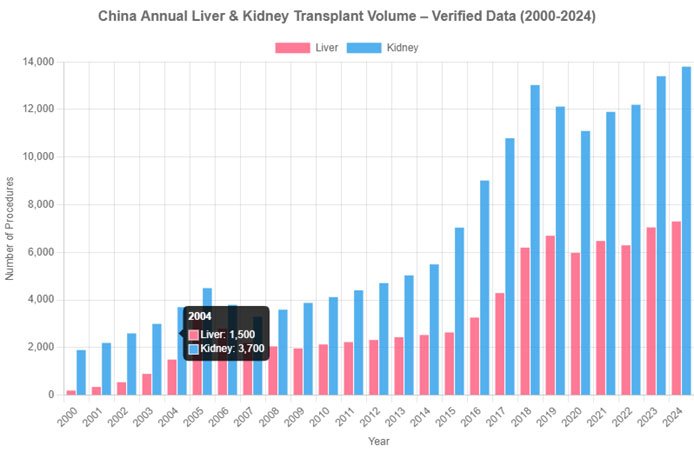
China performs the second-highest number of organ transplants in the world annually. The growth in kidney transplantation has been particularly dramatic, driven by a large patient population, increasing surgical expertise, and the expansion of the deceased donor program.
The following chart, based on verified data from the China Organ Transplantation Response System (COTRS), illustrates the steady rise in the annual volume of both liver and kidney transplants, demonstrating the massive scale of the national program.
Excellent Patient and Graft Survival Rates
The ultimate measure of a transplant program’s success is long-term patient and graft survival. Data from the China Scientific Registry of Kidney Transplantation (CSRKT), which collaborates with international registries, confirms that outcomes in China’s leading centers are internationally competitive.

Years Post-tx | Living-donor Graft | Living-donor Patient | Deceased-donor Graft | Deceased-donor Patient |
1 Year | 98.8 % | 99.0 % | 96.1 % | 97.2 % |
3 Years | 96.1 % | 97.4 % | 91.4 % | 93.8 % |
5 years | 92.5 % | 97.4 % | 87.8 % | 90.5 % |
Pioneering Techniques and a Comprehensive Clinical Model
Chinese transplant centers are not merely high-volume; they are at the forefront of surgical innovation and patient care.
Conclusion: An Established Destination for World-Class Care
The narrative of kidney transplantation in China is one of remarkable and rapid evolution. Through the establishment of a transparent, ethical regulatory system, the achievement of a massive clinical volume that hones expertise, and the publication of survival data that meets international standards, China has firmly positioned itself as a global leader in the field. For patients seeking a kidney transplant, China offers a compelling combination of scale, surgical proficiency, and scientific innovation, all within a system dedicated to achieving the best possible outcomes.


